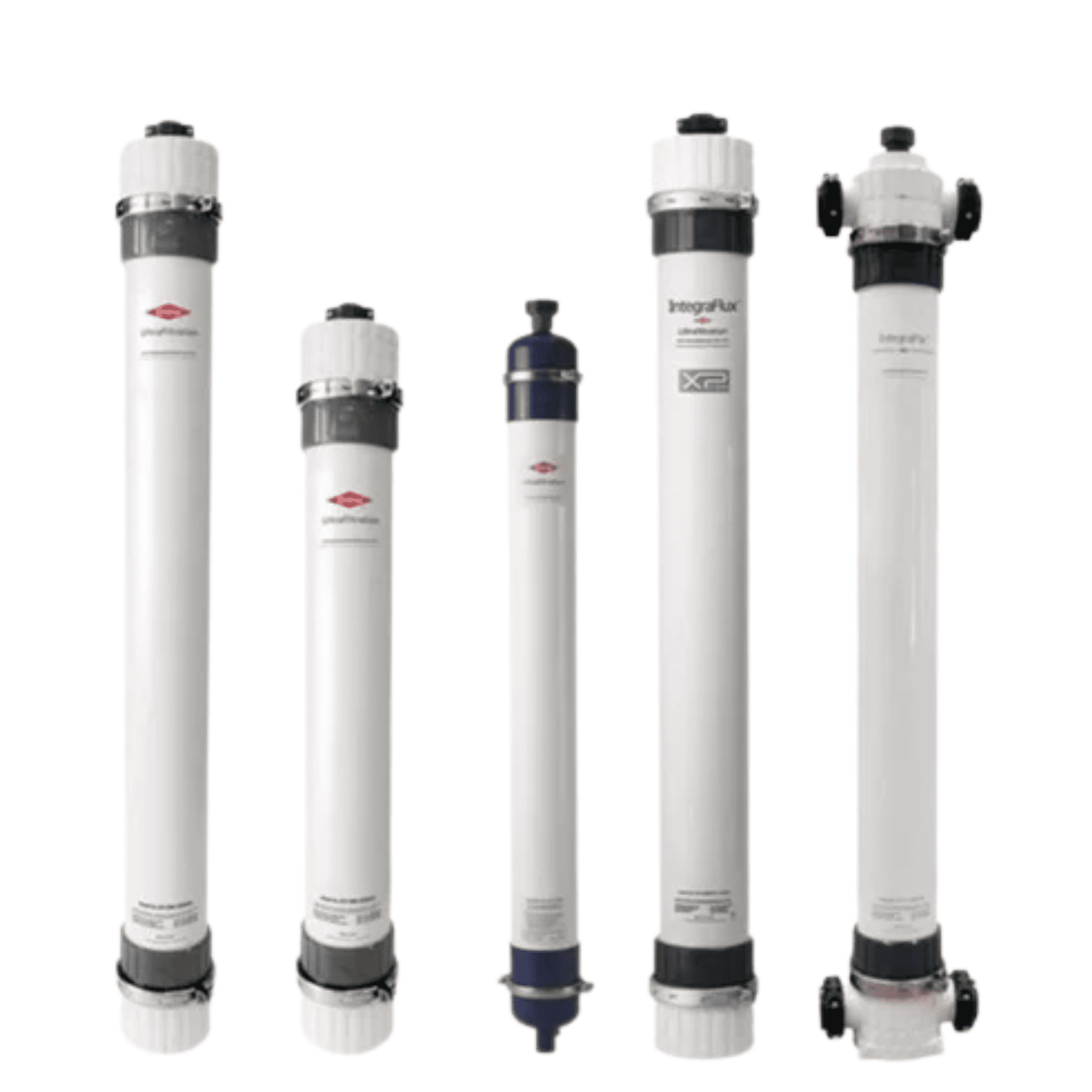
Ultrafiltration (UF) is a purification process that separates particulate matter from soluble compounds using an ultrafine membrane media. Ultrafiltration is an excellent separation technology for desalination pretreatment, reverse osmosis pretreatment, and wastewater reclamation, as well as for producing potable water.
- Details
- Benefits
- Features
- Applications
- Part & Acc
- Literature
lorem ipsum
The outside-in flow configuration is tolerant of wide-ranging feed water qualities and allows air scour cleaning. The dead-end flow offers higher recovery and energy savings. The pressurized vertical shell-and-tube design eliminates the need for separate pressure vessels and allows easy removal of air from cleaning along with integrity testing steps.
The hollow fiber ultrafiltration membranes are 1.3 mm outside diameter and 0.7 mm inside diameter and are made from PVDF polymer. The fibers are strong due to a combination of PVDF polymer, an asymmetric membrane with smaller pores in the active filtration area, and a high porosity substructure. PVDF membranes offer high chemical resistance (e.g., resistance to chlorine) and are tolerant to temperatures of 40°C.
- 0.03 μm nominal pore diameter to facilitate high-removal capability for bacteria, viruses, and particulates, including colloids.
- PVDF polymeric hollow fibers for high strength and chemical resistance.
- Hydrophilic PVDF fibers for easy cleaning and wettability to help maintain long-term performance.
- Outside-in flow configuration for high tolerance to feed solids and the use of air scour cleaning.
- U-PVC housings, which eliminate the need for pressure vessels and are resistant to UV light.
FilmTec™ NF elements can be used to purify public drinking water in areas where the high level of sodium rejection possible with reverse osmosis (RO)membranes is not needed, but where other salts such as calcium and magnesium must be reduced. Compared to lime softening and sodium chloride (NaCL) zeolite softening technologies, nanofiltration membrane softening is a less-expensive alternative. The FilmTec™ NF270 nanofiltration membrane, for example, offers low salt rejection, low energy consumption, and stable performance after repetitive cleaning. These features make it a prime choice for contaminated surface waters.
lorem ipsum 4